Axial flux windmill plans

or "How to build a wind turbine"

hugh@scoraigwind.co.uk
How to buy this book in English language
back to my main page


TRANSLATIONS: FRENCH
Follow the web link below.
SPANISH
click on link below
ITALIAN
Please contact Antonio and Beatrice direct by email.
Axial flux plans now also available
en Francais!

COMMENT CONSTRUIRE UNE EOLIENNE

CÓMO CONSTRUIR UN GENERADOR EÓLICO
bajatec
Axial flux windmill plans available in Italian

Come costruire un generatore eolico

TRADUZIONE ITALIANA
di Antonio Cecere e Beatrice Paparella 
"acecere" <awttce@tin.it>


"How to Build a Wind Turbine" is a 64 page A4 booklet containing full step-by-step instructions for building your own 'axial flux' alternator, carving the blades and welding a frame, to complete an 8 foot diameter, 3-bladed, battery-charging wind generator (12, 24 or 48 volts DC).  Larger and smaller projects are also briefly described.  There are full lists of materials, suppliers and tools for the job.  The design is based on the author's 25 years of experience building, and teaching  people to build small wind turbines using the minimum of workshop technology.

"I was totally astounded to find your book in my mailbox yesterday. How it made it from deepest, darkest Scotland to deepest, brightest Arizona in four days I'll never know, but thanks for the fast service.

The book appears to be excellent on a first skim, with brilliant diagrams. I'm looking forward to building one and adding it to our system (we live totally on solar power, seven miles from the nearest mains line).

Cheers,

Jonathan Hanson"
This document has now superceded my old brakedrum windmill plans although the latter will still be of interest to some readers.
The axial design is easier to build and involves less hunting around for parts.
The brakedrum idea had a lot going for it, but it's not the way I would do it now (ten years on). The term 'axial flux' refers to a type of alternator where the magnets are mounted on disks and the flux between them is parallel to the axis of the shaft.  This is unlike conventional alternators whose flux is radial across the air gap. My older brakedrum alternator design is a radial flux type.


In recent years I have been developing construction techniques for axial flux alternators.  In 2001, I made a construction manual available for free down load from this site.  Since then I have taught a lot of courses and my ideas have moved forward.  I have made the process simpler and I have made the alternator much more powerful by using neodymium magnets.

You can see pictures of the construction process in action during my workshop courses by going to the pagesfor the courses.

There are two slightly different versions of the design - one using inches and one using metric measurements.  Both are described in full in the plans.  At the end of the document there are also plans for a three other sizes of wind turbine.


LINKS

There is a very nice new page at blueEnergy in August 2004 with pretty pictures of the US version being built.

There is a lot of exciting new stuff going on at the Otherpower discussion board where Dan Bartmann is extending the design.  Watch out for the photo diaries of his monday sessions.  

Dan Fink at Otherpower has also done a thoughtful page about the nitty gritty of the process, warts and all.

For my other books click here


How to buy these 'Axial flux windmill plans' direct from me


Bryan Thomas wrote: Hy Hugh.  I just ordered your plans on how to build a wind turbine, and I had to type my credit card number with no spaces or no dashes in order for the Pay Pal order to work.  I suggest that when you ask for the customers credit card number, you put, in parenthesis, (no spaces), just to avoid possible confusion, and also to avoid the possibility of missed sales.  Keep up the good work on the good fight though and thanks for the reasonable price on the plans.

PLEASE NOTE THAT ORDERS SENT BY SNAIL MAIL WILL NOT BE DEALT WITH UNTIL 20TH JANUARY AS I AM AWAY TO SOUTH AFRICA.

Checks or money orders in pounds

including postage

in UK £12.00 GBP

in Europe £13.00 GBP

World £14.00 GBP

Here is my address :
Hugh Piggott
 Scoraig, Dundonnell, 
Ross shire, IV23 2RE
UK


Cash payments

including postage

in UK £12.00 GBP

Europe € 20 EUR

World $30 USD

If you want to pay with US$ or Euros, please send cash and not checks or money orders from overseas.  UK cheques in pounds are OK
If you send a foreign currency money order the bank will steal half of it (no kidding).

also now available from  in the USA
and from CAT Mail Order: +44 (0)1654 705959 in the UK


click here for a series of snapshots of the document (rather out of date), or read on for full details....

Dear Hugh,
I just finished your latest book.  Damn, it's good. Great information and written very clearly.  If you are ever near Denver Colorado and want to get a beer let me know.
Sincerely.
John Steele
I have bought a copy of your axial flux design handbook and its a very interesting and educational book to read on how to build a wind power. I read it for a hundred times already learning on how the system  works especially  the mechanical side of the furling system and up to the electrical. Wow, its so nice of you to write something that detailed more especially on the construction of the blades.

Going on the work from the construction of the blade I was really impressed on how the blade look  like after I've finish one. The aerodynamic design was so fantastic.

Best Regards,
Gene Antiquena
 

Hello Hugh,

Received the Feb 2004 version of your windmill plans. I have not been able
to let it get to far away from me since receiving it !!!!  My wife thinks I
may have finally cracked.

Oh well what can I say !!!!!!!!!!

Jeff Reitz


"I like the plans and the info, I really feel like I
understand everything in it....
What I really liked was the way the "Little Pancake" machine was thrown in at the end. With just a couple of pages we have a complete constuction plan, once we know the principals. Reminds me of house plans, all you need is some drawings, notes, a good material list and someone to ask questions when you get stuck. "

Ron Dinishak

  I ordered your wind turbine plans in January of this year. Well I have just put up the wind turbine and thought you would like a picture. It was my sons idea to write Got Wind on the vane.
Thank you for plans that work.
Kindest regards, Gordon
P.S. your plans are underpriced


 The eight foot diameter rotor machine with 500 watt output.
The smaller one (below) is half the diameter and  one quarter of the output.
We only use a single magnet disk on the smaller machine.
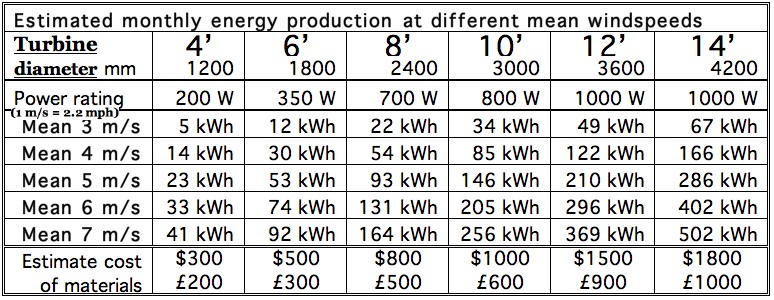
The plans also descirbe how to build 10 foot and 12 foot diameter wind turbines.
[Metric sizes are also given in the text: 1.2, 2.4 3 and 3.6 metres diameter]


CONTENTS:

Introduction 3
Blades 3
Alternator 3
Grid connection 3
Furling system 4
Units 4
Design decision: where to fit the rectifier 4
Some rules for adapting the design 4
8' [2.4m] machine construction - materials list 6
Notes on workshop safety 10
BLADE THEORY 11
Blade power 11
Blade speed 11
Blade number 11
Blade shape 11
Carving the blades 12
STEP ONE is to create the tapered shape. 12
STEP TWO carving the twisted windward face 12
Checking the drop 13
STEP THREE carving the thickness 13
STEP FOUR Carve the curved shape on the back of the blade 14
STEP FIVE Assembling the rotor hub. 15
Cutting the roots to 120 degrees 15
Marking and drilling the plywood disks 15
Clamping the blades together 15
Drilling holes for the mounting bolts 16
STEP SIX Cutting out and gluing on the wedges 16
ALTERNATOR THEORY 17
Preparing the bearing hub 18
Drilling out the 1/2' [12 mm] holes in the flange 18
Fabricating the alternator mounts 19
The Yaw Bearing 19
Alternator mounting bracket 19
Stator mounting brackets 20
Mounting the stub shaft/axle 21
Vauxhall / Opel hub 21
Trailer hub and stub axle 21
USA GM hub 21
Drilling the magnet rotor plates 22
Making the stator mould 23
Mark out the shape of the stator. 23
Cut out the stator shape in plywood. 24
Screw the mould to its base 24
Making the coil winder 25
ELECTRICAL THEORY 26
Winding the coils 26
Connecting the coils 27
Hints for soldering 27
Soldering the coil tails 27
The ring neutral 28
The output wiring 28
Casting the stator 29
Putting it together 29
Removing the casting from the mould 30
The magnet-positioning jig 30
Making the two rotor moulds 32
Parts of the moulds 32
Casting the rotors 33
Handling the magnets 33
Gluing the magnets to the disks 33
Dry run 33
Checking for magnet polarity 33
Preparation for casting the rotors 33
Putting it together 33
FURLING SYSTEM THEORY 34
Why furl? 34
How the furling tail works 34
Controlling the thrust force 35
Fabricating the tail hinge 36
The tail itself 37
Cutting out the tail vane 38
Mounting the rectifier box 39
Assembling the alternator 40
Preparation 40
Hub and shaft 40
Stator mounting holes 40
Back magnet rotor 40
The stator 41
Front magnet rotor 41
Connecting the rectifier 42
Testing the alternator 42

Short circuit tests 42
AC voltage tests 42
DC voltage tests 42
Connecting to the battery 43
Connecting the battery 43
Fuses or circuit breakers 43
Connections 43
Brake switch 43
Safety 43
Choosing suitable wire sizes 44
Wire type 44
Fitting and balancing the blades 45
Checking the tracking 45
Balancing the rotor 45
Fine tuning 46
Guyed tower ideas 47
Controlling the battery charge rate 48
Shunt regulator circuit 48
10 foot [3 metre] wind turbine 49
Wiring connections 49
12 foot [3.6m] wind turbine 50
The stator 50
Winding details 50
Wiring and connections 51
Magnet rotors (2 in number) 52
Alternator Mounts 52
Blade Dimensions 54
Making the plywood triangle 54
Tail hinge design 55
The moment of weight of the tail 56
4 foot [1.2m] diameter wind turbine 57
Blades 57
Bearing hub 57
The shaft 58
Rotor moulding 58
Stator mould 60
Assembly of the stator 60
The yaw bearing 61
The tail bearing and tail 61
Wiring up the battery 62
Using polyester resin 63
Mould preparation 63
Workshop tools 64

Some snapshots.

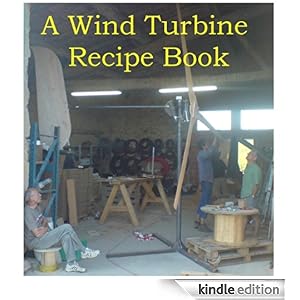
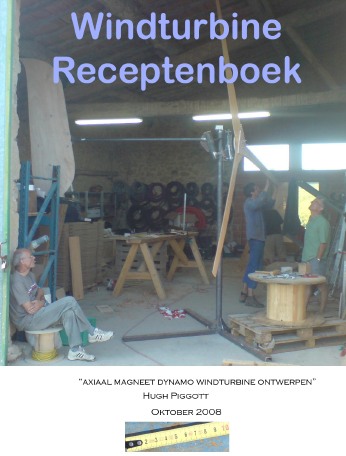
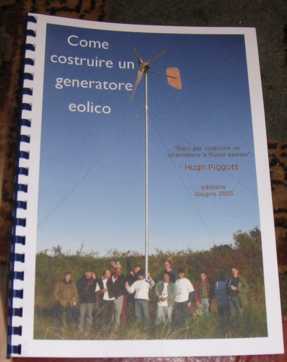
The cover changes as I bring out new editions....  the OLDER one shown here is May 2004,.
I AM NOW SHIPPING THE JUNE 2005 EDITION WITH MANY IMPROVEMENTS..


if you wish to grid connect this wind turbine, please check this link for more information